
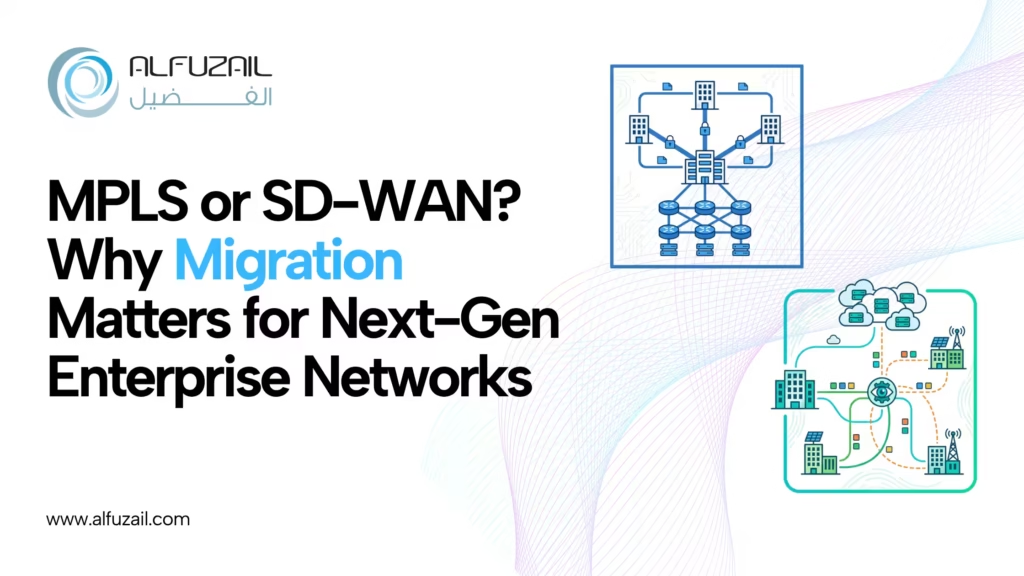
For over two decades, MPLS (Multiprotocol Label Switching) has been the backbone of enterprise connectivity, offering reliable performance and guaranteed Quality of Service (QoS). But as enterprises shift to cloud-first models, adopt SaaS platforms, and enable remote workforces, the limitations of a legacy MPLS network are increasingly evident. Enter SD-WAN solutions, a software-defined approach to networking that promises agility, cost savings, and cloud-native performance.
In this blog, we’ll explore the differences between MPLS and SD-WAN technology, highlight why enterprises are migrating, and provide actionable insights for building the next-generation network.
Understanding MPLS: The Legacy Backbone
MPLS protocol was designed for predictable routing, traffic engineering, and secure connections. It has long been favored by large enterprises that demand stability and guaranteed performance.
Key Features of MPLS
- Traffic prioritization: Ideal for latency-sensitive applications like VoIP.
- Dedicated connectivity: Ensures consistent bandwidth and performance.
- Reliability: Strong uptime supported by global MPLS providers.
Limitations of MPLS
- High cost: Premium pricing compared to internet-based options.
- Lack of cloud optimization: Poor adaptability to SaaS and multi-cloud traffic.
- Inflexibility: Scaling requires additional MPLS connection capacity and long lead times.
What is SD-WAN? The Agile Alternative
SD-WAN architecture leverages multiple types of connectivity (broadband, LTE, 5G, and even legacy MPLS connection) to intelligently route traffic. It’s designed for agility and performance in today’s distributed enterprise environments.
Key Features of SD-WAN
- Application-aware routing: Ensures traffic is directed over the best available link.
- Cloud-native integration: Seamless performance for Microsoft 365, Salesforce, AWS, Azure, and Google Cloud.
- Centralized management: Unified control and visibility across all sites.
- Security: Integrated next-gen firewalls, zero-trust policies, and encryption.
Comparing Architectures: MPLS vs. SD-WAN
| Feature | MPLS Network | SD-WAN Architecture |
| Connectivity | Private circuits managed by carriers | Overlay using broadband, MPLS, LTE, with encrypted tunnels |
| Scalability | Slow, hardware-dependent | Rapid provisioning, centralized policy deployment |
| Cost | High (dedicated circuits) | Cost-efficient (leverages public internet and hybrid links) |
| Traffic Optimization | Static, predetermined paths | Dynamic, app-aware, with failover and load-balancing |
| Cloud Integration | Indirect, backhauling common | Direct-to-cloud routing, ideal for SaaS and cloud apps |
| Security | Inherently private, but static routing | Built-in encryption, integrated security, SASE ready |
| Management | Complex, manual provisioning | Centralized, software-driven orchestration |
| Performance | Predictable, stable | Application-aware and adaptive |
Why Enterprises are Migrating from MPLS to SD-WAN
1. Reduced Total Cost of Ownership (TCO)
SD-WAN enables businesses to decommission expensive MPLS circuits and adopt cost-efficient Internet links. Enterprises save up to 40% by replacing or augmenting expensive MPLS providers with broadband and 5G.
2. Improved Application Performance
SD-WAN delivers intelligent traffic steering by routing user-critical traffic (like VoIP or CRM) across optimal paths to reduce latency and jitter compared to static MPLS circuits.
3. Security & Cloud Integration
By integrating firewalls, CASB, and zero-trust access into the WAN layer, SD-WAN aligns seamlessly with modern SASE architectures enhancing security without compromising performance, surpassing the static security posture of MPLS protocol.
4. Operational Simplicity
Enterprises can configure new branch routing policies centrally, avoiding site-by-site MPLS provisioning delays. It scales faster and consumes fewer IT resources.
5. Hybrid WAN Flexibility
SD-WAN can augment existing MPLS or phase it out gradually. This hybrid approach blends control and cost-efficiency while ensuring continuity of critical services.
Real-World Use Case: Financial Institution Migration
A regional bank migrated 35 branches using hybrid SD-WAN architecture:
- Retained MPLS for high-priority trading traffic
- Offloaded SaaS and internet-bound traffic to broadband
- Reduced bandwidth costs by 40%
- Improved performance for cloud applications by 30%
- Achieved centralized control and automated policy deployment
Emerging Technologies Complementing SD-WAN
One often overlooked element in WAN discussions is the role of complementary technologies. For instance, a MoCA Ethernet adapter can optimize last-mile connectivity in branch or home-office setups, ensuring high-speed traffic routing before it reaches the broader SD-WAN fabric.
Challenges in Migration: What to Expect
Migrating from MPLS to SD-WAN solutions isn’t without hurdles:
- Integration complexity with existing legacy systems.
- Change management for IT teams accustomed to MPLS providers.
- Vendor selection in a crowded market of SD-WAN router options.
The key is working with experienced integration partners who can balance cost savings with enterprise-grade performance.
Migration Best Practices
Hybrid Approach: Use MPLS connection for mission-critical apps while routing general internet traffic over SD-WAN router paths.
Vendor Validation: Choose vendors with proven SD-WAN architecture deployments across industries.
Network Assessment: Audit your current MPLS estates like traffic profiles, performance requirements, uptime SLA.
Pilot & Phased Rollout: Start SD-WAN in a non-critical site to test application routing, failover, and QoS policies.
Ensure Security: Deploy edge encryption, firewall integration, and segment WAN traffic according to application class. Ensure compliance with industry standards like ISO 27001, HIPAA, and PCI DSS.
Prioritize Transport Paths: Categorize application traffic and enforce real-time routing policies e.g., MPLS for ERP, broadband for cloud apps.
Monitor Performance: Use analytics to track latency, packet loss, jitter, and ROI improvements. Continuous measurement paints the migration success story.
Future Outlook: SD-WAN as the Foundation for SASE
The next evolution beyond SD-WAN solutions is Secure Access Service Edge (SASE), converging networking and security into a unified, cloud-native service. Migrating away from MPLS protocol today sets enterprises up for success in the SASE era, where agility, cloud optimization, and zero-trust are paramount.
Final Thoughts
While MPLS still serves enterprises requiring guaranteed performance, the future is undoubtedly software-defined. SD-WAN solutions bring unmatched agility, cost savings, and cloud-readiness, making them the cornerstone of next-generation enterprise connectivity.
At Al Fuzail, we help enterprises design, deploy, and optimize advanced networking strategies from MPLS protocol evaluations to full-scale SD-WAN architecture migrations. Our experts deliver future-proof solutions tailored to your business goals.Ready to migrate your enterprise network? Contact us today for network assessment & WAN modernization plan and start your journey to smarter, more agile connectivity.