
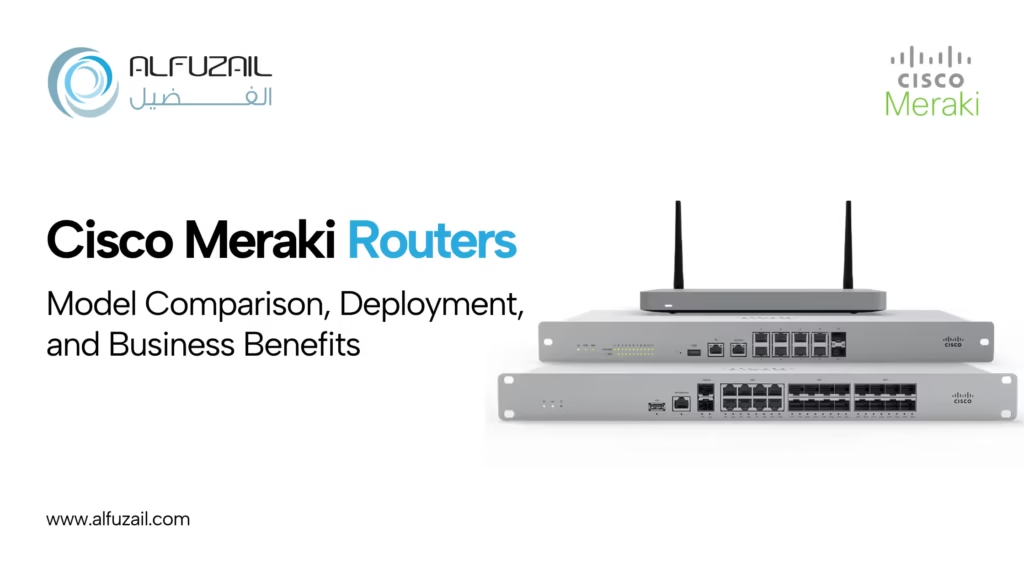
In the era of cloud-first networking and hybrid work, enterprises demand routers that deliver scalability, security, and centralized management. Cisco Meraki router models stand out by offering cloud-managed SD-WAN and security appliances with zero-touch provisioning, unified policy control, and seamless integration across networks and devices.
Meraki’s dashboard provides holistic oversight of connectivity, application performance, and threat visibility all from a cloud-native interface.
Comparing the Cisco Meraki Routing Lineup
| Deployment Scenario | Recommended Cisco Meraki Model(s) | Key Features |
| Small branch/remote | MX67, MX68, MX67C/W, MX68CW | 700 Mbps throughput, built-in Wi-Fi or LTE in some models |
| Mid-size branch | MX75, MX85 | 1 Gbps routing, 200–250 users |
| Large branch/campus | MX95, MX105 | 2–3 Gbps, supports 500–750 users |
| Campus/VPN hub | MX250, MX450 | 4–10 Gbps throughput, thousands of users |
| Cloud deployments | vMX (Small to X-Large) | Virtual MX for AWS, Azure, GCP with scalable throughput |
Meraki also integrates with Cisco ISR router models like the ISR 1000 and 4000 Series for firms requiring IOS XE features like advanced security and DNA integration. For wireless-enabled routing, Cisco offers wireless router models beyond Meraki, including Catalyst and ISR models for converged branch deployments.
Deployment Scenarios & Best Practices
Small Branch Setup
Deploying an MX67C offers built-in LTE failover for remote sites, ideal for unpatched uptime when primary WAN fails. Use Meraki dashboard for policy pushing and firmware control.
Campus Edge / Data Center Hub
An MX450 provides ultra-high throughput and multi-gig interfaces (10G SFP+), perfect for aggregating SD-WAN traffic or VPN termination.
Cloud-Native Deployments
Virtual Meraki (vMX) appliances plug directly into cloud infrastructures, offering virtualized routing and SD-WAN benefits with centralized configuration.
Hybrid Designs
Combining Meraki edge routers with Cisco ISR router models lets organizations orchestrate advanced services (e.g., network virtualization, high-performance routing) while maintaining unified visibility via Cisco platforms.
Business Benefits of Cisco Meraki Routers
Rapid, Scalable Deployment
Zero-touch provisioning via cloud dashboard enables quick rollouts across global sites, no on-site IT configuration needed.
Unified, Cloud-Managed Control
Manage all deployed sites, whether MX appliances or Meraki access points through a single pane, simplifying operations and troubleshooting.
Built-in Security & SD-WAN
Meraki MX models unify firewall, IPS, content filtering, and SD-WAN with app-aware routing and WAN failover built-in ideal for secure, distributed networks.
Cost Efficiency
A financial services provider using Meraki SD-WAN experienced 20–40% WAN cost savings across branches by replacing MPLS with broadband Hybrid WAN
Future-Ready Flexibility
From on-premise models to vMX, Meraki architecture scales with evolving business needs, especially crucial for multi-cloud and distributed environments.
Meraki Licensing Models & ROI
Meraki uses subscription licensing that covers hardware, software, and support. Organizations can choose Enterprise, Advanced Security, or Secure SD-WAN Plus licenses depending on needed features including advanced malware protection and analytics.
Co-terminated licensing helps simplify renewals and ROI tracking across device portfolios.
Case Highlight: Financial Sector Impact
A financial institution rolled out Meraki SD-WAN across 42 branch sites, achieving:
- 40% reduction in WAN costs
- Full remote configuration via cloud dashboard
- Seamless integration with Meraki’s wireless, switch, and IoT solutions
Choosing the Right Model: Decision Flow
- Identify deployment scale –SMB, branch, campus, or cloud.
- Match throughput needs –Per table above.
- Choose form factor –Physical MX vs. virtual vMX.
- Select license level –Ensure feature alignment.
- Plan integration –Meraki only vs. hybrid Cisco edge deployments.
Cisco Meraki Router Models vs Traditional Routers
When comparing Cisco Meraki router models with traditional enterprise routers, the difference lies in cloud-first management. While legacy systems rely heavily on manual configuration, Cisco routers models such as the MX series offer centralized dashboards, automated firmware updates, and AI-driven insights. This reduces downtime, optimizes performance, and simplifies large-scale deployments across distributed enterprises.
Comparison Snapshot:
| Feature | Traditional Routers | Cisco Meraki Router Models |
| Management | On-premises, manual | Cloud-based dashboard |
| Updates | Manual, patch-based | Automatic, cloud-pushed |
| Security | Basic firewall | Advanced SD-WAN + Security |
| Scalability | Limited | Highly scalable for multi-branch |
Security Features Across Cisco Router Models
Security is a defining factor in modern networks, and Cisco ISR router models and Cisco wireless router models stand out by offering built-in, enterprise-grade defenses.
Key security features include:
- Next-Gen Firewall (NGFW) integration with IDS/IPS.
- Zero Trust Network Access (ZTNA) for hybrid workforces.
- Advanced Malware Protection (AMP) powered by Cisco Talos threat intelligence.
- Encrypted Traffic Analytics (ETA) for identifying threats hidden in encrypted traffic.
This makes Meraki routers not just connectivity devices, but full-scale security enablers for cloud-first businesses.
Future of Cisco Meraki Router Models in AI-Driven Networking
Looking ahead, Cisco Meraki router models are aligning with AI-driven network automation. By leveraging machine learning algorithms and predictive analytics, businesses can expect:
- Automated traffic optimization based on application needs.
- Proactive threat detection and real-time response.
- Energy-efficient networking aligned with sustainability goals.
- Seamless integration with IoT and edge computing use cases.
Industry experts predict that AI-driven Cisco routers models will reduce operational costs by up to 40% by 2027 while improving uptime and network resilience.
Conclusion: Transform Networking with Meraki
Cisco Meraki router models deliver cloud-natively managed, scalable, and secure routing for modern enterprises. From small branch appliances to high-performance campus routers and virtual instances, Meraki simplifies deployment and saves OPEX while supporting agile, distributed networks.
At Alfuzail, we specialize in designing, deploying, and managing Cisco Meraki routers tailored to your architecture, whether it’s SD-WAN, cloud-native integration, or secure campus solutions. Let’s architect your next-gen, Meraki-led network together. Contact our experts today.